

Count to 10^60.
You can’t.
Don’t worry, there’s nothing wrong with you. Truth is, nobody can. We’re talking about a number with 60 zeros!
To put a little perspective on this number, it’s more than every atom in the observable universe, and more than every star in every galaxy we’ve ever seen.
My point is, our brains can’t even conceptualize this number.
And that’s how many possible drug-like chemical compounds exist.
Look, traditional drug discovery actually is simple. You just pick a disease, screen a few million molecules from existing libraries, and hope something sticks.
Then, you spend a decade optimizing it.
Of course, Phase I trials only succeed about half the time. And what about Phase II? Well, that success rate goes down to about one-third. 52% of the time.
So, that means from concept to FDA green light, we’re talking up to 15 years and nearly $3 billion.
What’s worse is that for all the advancements we’ve made, those odds haven’t changed in half a century.
Until now.
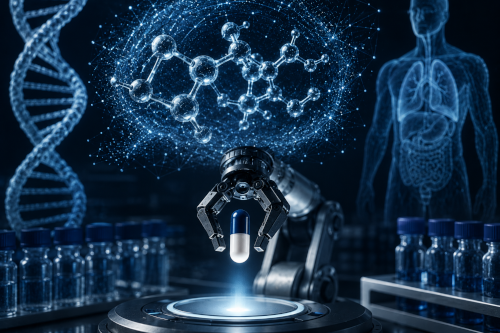
The peculiar part about using AI technology for drug discovery is that it doesn’t screen for existing chemical compounds.
Instead, it generates new ones from scratch — billions of virtual compounds designed computationally before a single test tube gets touched.
That ability to explore chemical space that no human would ever consider is the true advantage — the right platform predicts toxicity, binding affinity, and drug-like properties before synthesis.
And recently, Insilico Medicine proved it works.
The company took its target discovery to Phase IIa clinical results in under four years, and published it in Nature Medicine last June.
The drug — rentosertib — improved lung function by 98.4 mL while placebo patients declined.
If you’re keeping track, that’s the first fully AI-designed drug candidate to demonstrate clinical efficacy in humans.
In fact, the FDA expects the first AI-discovered drug approval within six months.
Right now, there are 173 AI-originated drugs in clinical trials, with about 15-20 entering pivotal trials this year.
Last week, Google’s pharmaceutical spinout raised $2.1 billion to scale its AI drug design platform toward clinical trials.
This isn’t some VC firm gambling on a science experiment dear reader.
It’s a $4.65 TRILLION tech giant teaming up with sovereign wealth funds from three continents (as well as some of the smartest money in Silicon Valley) betting that the 10^60 problem just became solvable.
And they’re not alone.
Sometimes, things fall into our laps thanks to pure luck.
Back in 1928, Alexander Fleming discovered penicillin by accident when he came back from vacation and found a petri dish contaminated with mold. Then, he just happened to notice the bacteria around it had died — pure luck.
It then took 17 years before penicillin could be mass-produced and deployed to save soldiers in World War II.
But AI-designed drugs aren’t accidents.
They’re engineered.
Between 2021 and 2024, Insilico Medicine’s platform nominated 22 candidates, averaging about 12-18 months from project start to becoming a preclinical candidate.
Under traditional discovery methods, that would take up to 4 years to accomplish.
And what about the average number of compounds Insilico synthesized to find each candidate? Well, that was about 60 to 200… whereas traditional methods test thousands.
The math explains why Big Pharma stopped building internal research labs and started writing billion-dollar checks to AI companies.
Last week, Isomorphic Labs — the drug discovery company spun out of Google DeepMind — announced a $2.1 billion funding round led by Thrive Capital.
Not only did Alphabet double down on its investment, but so did sovereign wealth funds from Abu Dhabi, Singapore, and the United Kingdom.
Isomorphic was founded by Demis Hassabis, the DeepMind co-founder who won the 2024 Nobel Prize in Chemistry for AlphaFold—the AI system that solved the protein folding problem. AlphaFold predicted the 3D structure of proteins from DNA sequences, a task that used to take years of experimental work. Hassabis built Isomorphic to take that capability and turn it into drugs.
Not only does the company have 17 active drug development programs spanning oncology, immunology, and cardiovascular disease, but it’s already inking partnerships with three of the world’s largest pharmaceutical companies.
- Eli Lilly committed $45 million upfront with milestone payments potentially reaching $1.7 billion.
- Novartis signed for $37.5 million upfront, then expanded the deal in February 2025.
- And Johnson & Johnson joined in January 2026 for a multi-target research collaboration.
The floodgates are opening, and it’s only a matter of time before the regulatory landscape shifts in lockstep.
Right now, roughly 81% percent of pharmaceutical companies are using AI in drug development — not piloting it, using it.
The technology works, and the only thing left is execution — and the window before the entire sector re-prices this technology is closing fast.
Fleming’s penicillin saved an estimated 200 million lives, and it took more than a decade and a half to mass-produce because the antibiotics didn’t exist yet.
You see, it was Howard Florey and Ernst Boris Chain that spent a decade figuring out industrial-scale fermentation before penicillin could be shipped to battlefield hospitals.
Now, AI-designed drugs are reaching Phase IIa in just a few years, and the infrastructure to scale already exists. That’s not to mention the fact that the FDA framework is in place and capital is flowing.
But the companies building AI drug discovery platforms aren’t selling software — they’re compressing the timeline between disease and cure.
When Phase I success rates double and development timelines shrink by 40%, we’re looking at a new era of drug discovery.
Fleming didn’t need to understand fermentation chemistry to know penicillin would change medicine.
Early investors in antibiotic manufacturers didn’t need to either. They just needed to see that the technology worked and the market was massive.
We know AI drug discovery works, and Google just bet $2.1 billion on a company with zero drugs approved yet.
But here’s the catch…
How about I show you the small biotech player that’s further along than Isomorphic — and why it’s going to beat Google to the punch.
Until next time,

Keith Kohl
 Check us out on YouTube!
A true insider in the technology and energy markets, Keith’s research has helped everyday investors capitalize from the rapid adoption of new technology trends and energy transitions. Keith connects with hundreds of thousands of readers as the Managing Editor of Energy & Capital, as well as the investment director of Angel Publishing’s Energy Investor and Technology and Opportunity.
For nearly two decades, Keith has been providing in-depth coverage of the hottest investment trends before they go mainstream — from the shale oil and gas boom in the United States to the red-hot EV revolution currently underway. Keith and his readers have banked hundreds of winning trades on the 5G rollout and on key advancements in robotics and AI technology.
Keith’s keen trading acumen and investment research also extend all the way into the complex biotech sector, where he and his readers take advantage of the newest and most groundbreaking medical therapies being developed by nearly 1,000 biotech companies. His network includes hundreds of experts, from M.D.s and Ph.D.s to lab scientists grinding out the latest medical technology and treatments. You can join his vast investment community and target the most profitable biotech stocks in Keith’s Topline Trader advisory newsletter.


